
If you’re targeting keywords based solely on search volume, you’re playing a losing game. You might be getting traffic, but are you getting customers?
Traditional keyword research misses the most critical factor: purchase intent. This guide will teach you a fundamentally different approach to keyword research—one designed to attract people who are ready to take action, not just gather information.
Real-World Impact: By shifting a client’s focus from informational keywords to commercial investigation terms, we increased their lead-to-customer conversion rate from SEO by 300%, even though overall traffic temporarily dipped. The right traffic is infinitely more valuable.
The Fundamental Shift: From Search Volume to Searcher Intent
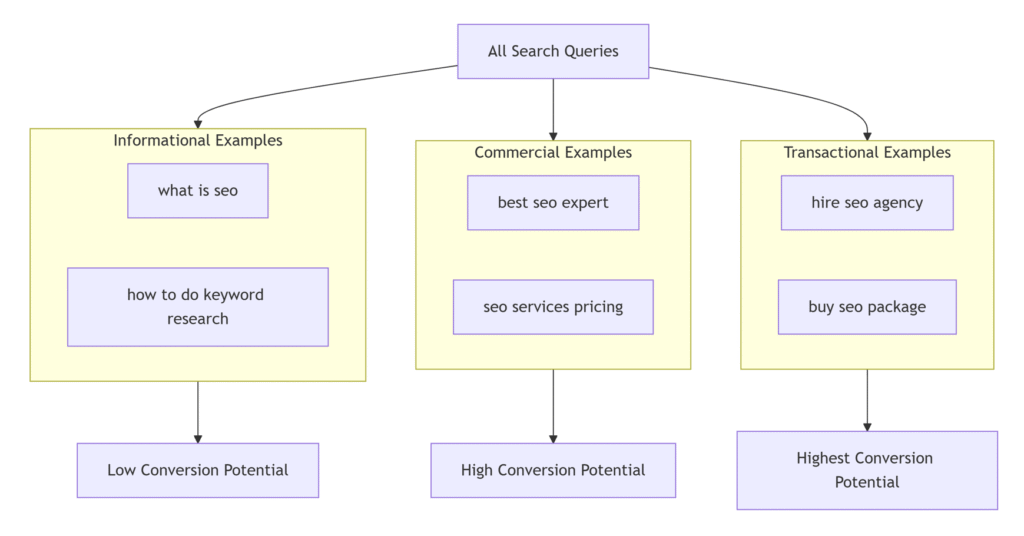
The core principle of lead-generation keyword research is understanding the goal behind the search. We categorize intent into three main tiers, visualized below:
The 4-Step Process for Finding High-Intent Keywords
Step 1: Uncover the Commercial Investigation Phrases
Your goal is to find keywords where the user is in “research mode.” They’re comparing options and getting closer to a decision.
Actionable Tactics:
- Use “Modifier” Keywords: Start with your core service (e.g., “SEO”) and add buyer-focused modifiers:
- “Best [service] for [problem]”
- “[Service] vs [competitor service]”
- “[Service] reviews”
- “[Service] pricing” / “[Service] cost”
- “[Service] packages”
- Mine “People Also Ask” and Related Searches: Google these are goldmines for understanding the questions people have during their commercial investigation. For “best SEO expert,” you’ll see questions like “How much does a good SEO expert cost?” and “What should I look for when hiring an SEO?”
Step 2: Analyze Your Existing Performance for Intent Gaps
Your current analytics hold the secrets to what’s already working—and what’s not.
Actionable Tactics:
- Google Search Console Analysis: Export your performance data. Filter for pages that rank for commercial intent keywords but have a low click-through rate (CTR). This indicates a conversion problem on the page itself—a perfect opportunity for optimization, which you can identify with our SEO Audit for Lead Generation.
- Google Analytics 4 Deep Dive: If you have goal tracking set up, identify which pages are already driving leads. Then, use GSC to see what keywords those pages rank for. Double down on those intent patterns.
Step 3: Competitor Spycraft for Lead Generation
Don’t just see who ranks #1; see who is ranking and converting.
Actionable Tactics:
- Identify Competitors’ Money Pages: Use a tool like Ahrefs or Semrush. Instead of looking at their blog, analyze their “Services,” “Pricing,” and “Case Studies” pages. These are their lead-generation engines. See what keywords these pages rank for.
- Reverse-Engineer Their PPC Keywords: Many tools show you the keywords competitors are bidding on in Google Ads. These are almost exclusively high-intent, commercial keywords because they have a direct cost. This list is a qualified lead shortlist.
Step 4: Map Keywords to the Conversion Funnel
Not all high-intent keywords are equal. You need to map them to the right page on your site to guide the user.
| Keyword Intent Level | Example Keywords | Best Page Type to Target |
| Early Commercial | “what is lead generation seo”, “seo for small business” | Pillar Page / Blog Post (Ungated, to build trust) |
| Mid-Funnel Commercial | “best seo expert for ecommerce”, “seo agency reviews” | Service Page / Landing Page (With strong CTAs) |
| Late-Funnel Commercial | “hire seo consultant”, “seo agency pricing” | Contact Page / “Request a Quote” Page (Direct conversion) |
Your Lead Generation Keyword Research Template
Copy this table to organize your findings:
| Keyword | Search Intent | Search Volume | Difficulty | Target Page | Priority (H/M/L) |
| “seo services” | Transactional | 22,000 | High | Services Page | H |
| “best seo expert for startups” | Commercial | 1,300 | Medium | Service Page / Landing Page | H |
| “how to improve seo” | Informational | 8,100 | Low | Blog Post | L |
| “seo agency vs in-house” | Commercial | 590 | Low | Service Page / Blog Post | M |
Priority Rule: A medium-volume, low-competition commercial intent keyword is almost always more valuable than a high-volume, high-competition informational keyword.
Common Mistakes to Avoid
- Ignoring Long-Tail Keywords: These are often highly specific and signal a user who knows exactly what they want. “SEO expert for ecommerce beauty brands” is a goldmine.
- Forgetting Local Intent: If you serve local clients, include “near me” and city-based modifiers. The intent is incredibly high.
- Not Updating Your List: Search intent evolves. A keyword that was informational two years ago might be commercial today. Revisit this process quarterly.
From Keywords to Conversions
Finding the right keywords is only half the battle. The next critical step is building content that satisfies the intent and persuades the user to act. This requires a deep understanding of how to structure your site, which we cover in our pillar page: SEO for Lead Generation: The Complete Guide.
Once you have your pages built, the work isn’t over. You must ensure they are technically sound and optimized to convert, which is covered in our guides on Technical SEO for Lead Generation and Creating High-Converting Landing Pages.
Struggling to Find the Right Keywords?
If this process feels overwhelming, you’re not alone. Extracting genuine commercial intent from raw data is a skill. We’ve honed this process for years to consistently deliver qualified leads for our clients.
Download Our Free Lead Generation Keyword Checklist or Book a Free Strategy Session to see how we can apply this exact methodology to your business.